Villas at Bryn Mawr Outpatient
275 Penn Avenue North, Minneapolis
Payment sources: Medicaid · Private insurance carriers
Types of care
DetoxInpatient and residential programsOutpatient care (IOP, PHP)Treatment with medication (MAT)Care for dual diagnosisRehab for alcohol useRehab for drug useGroup-specific programsSober living, transitional housingPayment for rehabCity list
SAMHSA records as of November 16, 2026
Treatment remains open to the uninsured. Funding sources: sliding fees, payment assistance, and county, state or federal budgets. SAMHSA's count for the state: 350 programs.
Useful on the call: an insurance card and a ZIP code, whether the call is for yourself or for someone else. This number: paid referral line, answered by a partner that runs none of the programs in this directory.

12 of 350 listings, per SAMHSA FindTreatment.gov (November 16, 2026). Sort order: programs with the most services reported to SAMHSA first, then A–Z. Inclusion costs programs nothing. Calls to the referral line are answered by a partner, which pays for the line, not by the listed programs. Listing method.
No clear starting point? Call (218) 408-7670 This number: paid referral line, answered by a partner that runs none of the programs in this directory.
275 Penn Avenue North, Minneapolis
Payment sources: Medicaid · Private insurance carriers
241 Highway 33 North, Cloquet
Payment sources: Medicaid · Private insurance carriers
1174 Western Avenue North, Fergus Falls
Payment sources: Medicaid
1401 8th Street South, Moorhead
Payment sources: Medicaid · Private insurance carriers · Sliding fee, income-based
22195 State 34, Nevis
Payment sources: Medicaid · Private insurance carriers
797 East 7th Street, Saint Paul
Payment sources: Medicaid · Private insurance carriers · Sliding fee, income-based
1100 Indus Street, Fairmont
Payment sources: Medicaid · Private insurance carriers
1185 North Concord Street, South Saint Paul
Payment sources: Medicaid · Private insurance carriers · Sliding fee, income-based
Accreditation (SAMHSA listing): CARF and Joint Commission
1262 Crossings Drive, Delano
Payment sources: Medicaid · Private insurance carriers
207 Jefferson Boulevard, Big Lake
Payment sources: Medicaid · Medicare · Private insurance carriers
924 Rice Street, Saint Paul
Payment sources: Medicaid
445 Etna Street, Saint Paul
Payment sources: Medicaid · Private insurance carriers
Facility data: public agencies only; advertisers excluded
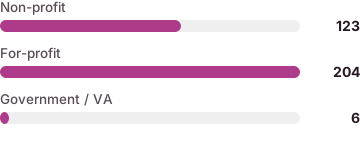
Options without insurance in Minnesota total 350 programs. Sliding fee scale: 74. Public funding: 345. Payment help: 81. Main locations: Minneapolis (68), Saint Paul (50) and Duluth (19). Source: SAMHSA locator, November 16, 2026[1].
Key points
If you have no health insurance, or your insurance does not cover the full cost of treatment, Minnesota's Behavioral Health Fund can pay for substance use disorder treatment when your household income is within the program's limits. Since July 1, 2026, the Minnesota Department of Human Services decides eligibility for the fund for all applicants, and you can apply directly through its online portal or by mail. If you qualify, you get 60 consecutive calendar days of eligibility to seek treatment, and the fund pays the treatment provider directly; the provider must be enrolled as a Minnesota Health Care Programs provider and may not require a co-payment from you for these services. People enrolled in Medical Assistance or MinnesotaCare are eligible for room and board services through the fund. You can choose where to get a comprehensive assessment and then use any enrolled provider licensed for the level of care it authorizes. If you are found ineligible, you have the right to appeal.
Uninsured care in Minnesota, by the numbers. Sliding fee scale: 74 listed programs. County, state or federal funds for patients unable to pay: 345. Payment help: 81. Priority rule: programs on federal Substance Use Block Grant funds give priority admission to two groups: people who inject drugs, and pregnant women.
333 of these programs also take Medicaid. For those who are eligible, Medicaid coverage widens the range of programs. Recommended order: get a price quote first, then put it into the cost calculator. Then the self-check suggests the level of care worth requesting.
Method: for each of Minnesota's 87 counties, straight-line miles from its midpoint to the nearest listing with low-cost options. Median result: 10.6 miles. Counties past 30 miles: 10.
| County | Distance, miles |
|---|---|
| Cook County | 79.7 |
| Lake of the Woods County | 60.4 |
| Kittson County | 53.2 |
| Roseau County | 47.5 |
| Big Stone County | 40.0 |
| Aitkin County | 36.7 |
| Lake County | 35.7 |
| Traverse County | 34.7 |
Other accepted payment
Many programs accept more than one payment type. Relevance: coverage can change mid-treatment.
Out of 350 total, 332 also accept cash; 74 apply a sliding fee scale.
Free, confidential, available 24/7. This number: paid referral line, answered by a partner that runs none of the programs in this directory.


Programs with low-cost options by city: 350 total
| City | Accepting | Total programs | Share |
|---|---|---|---|
| Minneapolis | 68 | 79 | 86% |
| Saint Paul | 50 | 56 | 89% |
| Duluth | 19 | 20 | 95% |
| Rochester | 15 | 16 | 94% |
| St Cloud | 9 | 11 | 82% |
| Grand Rapids | 7 | 8 | 88% |
| Mankato | 7 | 8 | 88% |
| Bemidji | 6 | 7 | 86% |
| Brainerd | 6 | 6 | 100% |
| Cloquet | 6 | 6 | 100% |
| Burnsville | 5 | 5 | 100% |
| Moorhead | 5 | 5 | 100% |
350 programs with low-cost options, broken down by level of care:
No program in mind yet? Call (218) 408-7670 This number: paid referral line, answered by a partner that runs none of the programs in this directory.
No clear starting point?
Points to confirm: sliding fees or public funding at each program, and the application route.
This number: paid referral line, answered by a partner that runs none of the programs in this directory.
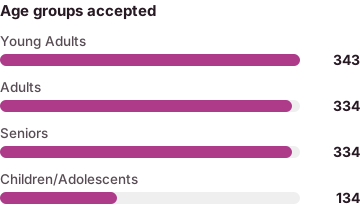
350 listings, counted by who they serve:
Leading entries: Young Adults (343 of 350), Adults (334 of 350), plus Seniors (334 of 350).
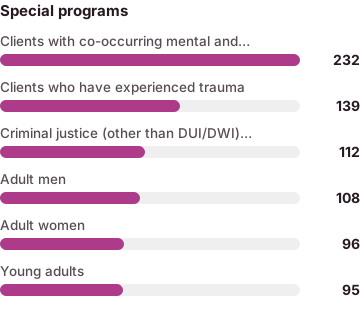
Leading entries: Clients with a dual diagnosis (mental illness plus substance use disorder) (232 of 350), Clients who have experienced trauma (139 of 350), plus Justice-involved clients (excluding DUI/DWI) (112 of 350).
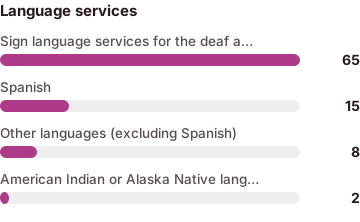
Leading entries: Sign language services for deaf and hard-of-hearing clients (65 of 350), Spanish (15 of 350), plus Other languages (excluding Spanish) (8 of 350).
Each program reports its care settings and its support after discharge.
Leading entries: Outpatient (285 of 350), Regular outpatient treatment (159 of 350), plus Intensive outpatient treatment (155 of 350).

Leading entries: Mentoring/peer support (266 of 350), Housing services (220 of 350), plus Assistance with obtaining social services (171 of 350).

Leading entries: Buprenorphine used in Treatment (104 of 350), Naltrexone used in Treatment (87 of 350), plus Methadone used in Treatment (13 of 350).

Leading entries: Cognitive behavioral therapy (333 of 350), Telemedicine/telehealth therapy (277 of 350), plus Substance use disorder counseling (214 of 350).

SAMHSA snapshot behind the facility counts: November 16, 2026.
Review date: November 16, 2026. Checked against the sources above by the Rehab Minnesota editorial team. Methodology.
Care without insurance: the essentials
Per SAMHSA's locator (November 16, 2026), 350 of 394 facilities in Minnesota qualify. Residential care: 88 of them. Detox: 17. Medication for opioid use disorder: 124 programs. Outpatient care: 285. Teens accepted: 134 of 350; Spanish-language services: 15. To ask whether any of the 350 has an opening, use the referral line (paid line; answered by a partner).
A fee tied to income and household size.
The program sets the amount after reviewing income documents, such as a tax return or pay stub. Minnesota: 74 programs on a sliding fee scale, 81 with payment help. Income documentation rules vary; ask each program, or use the referral line (paid line; answered by a partner).
Federal rule: Substance Use Block Grant programs admit, ahead of the general queue, pregnant women and people who inject drugs.
Other patients generally enter in order of application, so a waiting list is possible. Public funding is reported by 345 of the 350; 333 also accept Medicaid. Key point: enrolling in Medicaid opens up more of them.
Minneapolis leads with 68; next: Saint Paul (50), Duluth (19) and Rochester (15).
That equals 86% of the 79 programs listed in Minneapolis. Total reach: programs with low-cost options are found in 96 Minnesota cities. Table below: leading cities by program count, with each city's share.
Out of 350 total, 333 take Medicaid, 319 take private insurance, 163 take Medicare, 150 take TRICARE, 332 take cash and 74 use a sliding fee scale. More on this: Medicaid, private insurance, Medicare, TRICARE, or a patient-share estimate with the cost tool.
Most programs above will name their accepted plans on request; another route: the referral line.
This number: paid referral line, answered by a partner that runs none of the programs in this directory.
Payment for rehab