Empower Recovery Services
509 3rd Avenue SE, Pine City
Payment sources: Medicaid · Medicare · Private insurance carriers
Types of care
DetoxInpatient and residential programsOutpatient care (IOP, PHP)Treatment with medication (MAT)Care for dual diagnosisRehab for alcohol useRehab for drug useGroup-specific programsSober living, transitional housingPayment for rehabCity list
SAMHSA records as of November 16, 2026
Medicare covers rehab in three settings: hospitals, clinics, opioid treatment programs. Prescribed medicine: covered too. Among private programs, it is accepted less widely than Medicaid. SAMHSA's count for the state: 180 programs.
Useful on the call: an insurance card and a ZIP code, whether the call is for yourself or for someone else. This number: paid referral line, answered by a partner that runs none of the programs in this directory.

12 of 180 listings, per SAMHSA FindTreatment.gov (November 16, 2026). Sort order: programs with the most services reported to SAMHSA first, then A–Z. Inclusion costs programs nothing. Calls to the referral line are answered by a partner, which pays for the line, not by the listed programs. Listing method.
No clear starting point? Call (218) 408-7670 This number: paid referral line, answered by a partner that runs none of the programs in this directory.
509 3rd Avenue SE, Pine City
Payment sources: Medicaid · Medicare · Private insurance carriers
1400 Madison Avenue, Mankato
Payment sources: Medicaid · Medicare · Private insurance carriers
Accreditation (SAMHSA listing): Joint Commission
914 South 8th Street, Minneapolis
Payment sources: Medicaid · Medicare · Private insurance carriers
Accreditation (SAMHSA listing): Joint Commission
114 Minnesota Street, Sandstone
Payment sources: Medicaid · Medicare · Private insurance carriers
1705 Anne Street NW, Bemidji
Payment sources: Medicaid · Medicare · Private insurance carriers
Accreditation (SAMHSA listing): Joint Commission
451 Lexington Parkway North, Saint Paul
Payment sources: Medicaid · Medicare · Private insurance carriers
1741 15th Street NW, Bemidji
Payment sources: Medicaid · Medicare
2101 Minneahaha Avenue, Minneapolis
Payment sources: Medicaid · Medicare · Private insurance carriers
Accreditation (SAMHSA listing): Joint Commission
520 Osborne Road NE, Minneapolis
Payment sources: Medicaid · Medicare · Private insurance carriers
Accreditation (SAMHSA listing): Joint Commission
1000 Paul Parkway, Minneapolis
Payment sources: Medicaid · Medicare · Private insurance carriers
1900 Chicago Avenue South, Minneapolis
Payment sources: Medicaid · Medicare · Private insurance carriers
Accreditation (SAMHSA listing): CARF
3400 West 66th Street, Minneapolis
Payment sources: Medicaid · Medicare · Private insurance carriers
Accreditation (SAMHSA listing): Joint Commission
Facility data: public agencies only; advertisers excluded
Medicare is accepted at 180 of 394 programs in the state (46%). Medicaid reaches more: 360 programs. Medication for opioid use is available at 57 of the Medicare programs. Main locations: Minneapolis (42), Saint Paul (25) and Duluth (10). Source: SAMHSA locator, November 16, 2026[1].
Key points
Coverage by part. Part A: hospital inpatient stays, inpatient detox among them. Part B: outpatient counseling; intensive outpatient programs, covered from 2024; opioid treatment programs with methadone, covered from 2020. Part D: prescriptions such as buprenorphine, through drug plans.
Limits of Original Medicare: no payment for residential programs outside hospitals, and no annual out-of-pocket ceiling. By contrast with that, Medicare Advantage plans set a yearly ceiling; some also cover more inside their networks.
In this group, 57 programs provide medication for opioid use and 165 provide outpatient care. For people enrolled in both Medicare and Medicaid, Medicaid programs can pick up care outside Medicare's coverage.
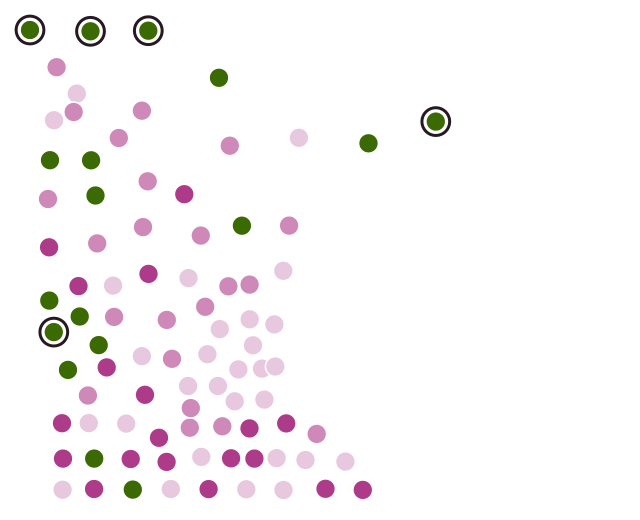
Method: for each of Minnesota's 87 counties, straight-line miles from its midpoint to the nearest listing accepting Medicare. Median result: 18.0 miles. Counties past 30 miles: 17.
| County | Distance, miles |
|---|---|
| Cook County | 79.7 |
| Lake of the Woods County | 60.4 |
| Big Stone County | 58.0 |
| Kittson County | 53.2 |
| Roseau County | 47.5 |
| Lac qui Parle County | 42.9 |
| Traverse County | 40.5 |
| Mahnomen County | 40.3 |
Other accepted payment
Many programs accept more than one payment type. Relevance: coverage can change mid-treatment.
Out of 180 total, 173 also accept cash; 49 apply a sliding fee scale.
Free, confidential, available 24/7. This number: paid referral line, answered by a partner that runs none of the programs in this directory.


Programs accepting Medicare by city: 180 total
| City | Accepting | Total programs | Share |
|---|---|---|---|
| Minneapolis | 42 | 79 | 53% |
| Saint Paul | 25 | 56 | 45% |
| Duluth | 10 | 20 | 50% |
| Bemidji | 7 | 7 | 100% |
| Rochester | 6 | 16 | 38% |
| Mankato | 5 | 8 | 62% |
| Brainerd | 4 | 6 | 67% |
| Cloquet | 4 | 6 | 67% |
| Grand Rapids | 4 | 8 | 50% |
| St Cloud | 4 | 11 | 36% |
| Albert Lea | 3 | 4 | 75% |
| Anoka | 3 | 6 | 50% |
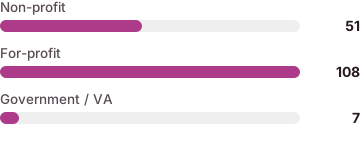
180 programs accepting Medicare, broken down by level of care:
No program in mind yet? Call (218) 408-7670 This number: paid referral line, answered by a partner that runs none of the programs in this directory.
No clear starting point?
Acceptance of Medicare plans varies by program; confirm it on each call.
This number: paid referral line, answered by a partner that runs none of the programs in this directory.
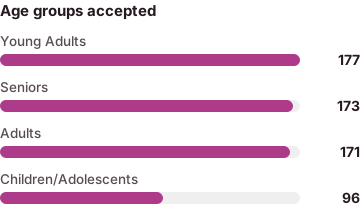
180 listings, counted by who they serve:
Leading entries: Young Adults (177 of 180), Seniors (173 of 180), plus Adults (171 of 180).
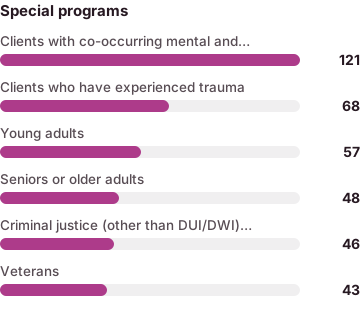
Leading entries: Clients with a dual diagnosis (mental illness plus substance use disorder) (121 of 180), Clients who have experienced trauma (68 of 180), plus Young adults (57 of 180).
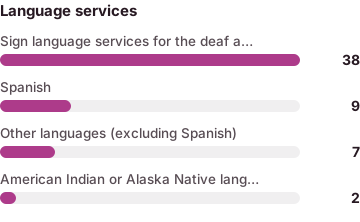
Leading entries: Sign language services for deaf and hard-of-hearing clients (38 of 180), Spanish (9 of 180), plus Other languages (excluding Spanish) (7 of 180).
Each program reports its care settings and its support after discharge.
Leading entries: Outpatient (165 of 180), Regular outpatient treatment (66 of 180), plus Intensive outpatient treatment (57 of 180).

Leading entries: Mentoring/peer support (119 of 180), Housing services (98 of 180), plus Assistance with obtaining social services (55 of 180).

Leading entries: Buprenorphine used in Treatment (47 of 180), Naltrexone used in Treatment (41 of 180), plus Methadone used in Treatment (13 of 180).

Leading entries: Cognitive behavioral therapy (170 of 180), Telemedicine/telehealth therapy (150 of 180), plus Individual psychotherapy (91 of 180).

SAMHSA snapshot behind the facility counts: November 16, 2026.
Review date: November 16, 2026. Checked against the sources above by the Rehab Minnesota editorial team. Methodology.
Medicare: the essentials
Per SAMHSA's locator (November 16, 2026), 180 of 394 facilities in Minnesota qualify. Residential care: 18 of them. Detox: 3. Medication for opioid use disorder: 57 programs. Outpatient care: 165. Teens accepted: 96 of 180; Spanish-language services: 9. To ask whether any of the 180 has an opening, use the referral line (paid line; answered by a partner).
Original Medicare covers hospital inpatient care. Residential programs outside hospitals fall outside it.
Certain Medicare Advantage plans go further; the plan's Evidence of Coverage has the specifics. Medicare is listed by 180 programs here: 18 with residential care, 3 with detox. Ask each whether its beds are classed as hospital inpatient care, or use the referral line (paid line; answered by a partner).
Yes.
Opioid treatment programs are a Part B benefit as of 2020. Methadone is included, together with the related counseling. Medication for opioid use disorder: 57 of the 180 Minnesota programs that accept Medicare. Ask which of them hold certification as an opioid treatment program.
Minneapolis leads with 42; next: Saint Paul (25), Duluth (10) and Bemidji (7).
That equals 53% of the 79 programs listed in Minneapolis. Total reach: programs accepting Medicare are found in 62 Minnesota cities. Table below: leading cities by program count, with each city's share.
Out of 180 total, 173 take Medicaid, 175 take private insurance, 116 take TRICARE, 173 take cash, 49 on a sliding fee scale, 163 with reported public funding. More on this: Medicaid, private insurance, TRICARE, no insurance, or a patient-share estimate with the cost tool.
Most programs above will name their accepted plans on request; another route: the referral line.
This number: paid referral line, answered by a partner that runs none of the programs in this directory.
Payment for rehab